Nobelprijs voor Literatuur 2026 voor Anne Carson
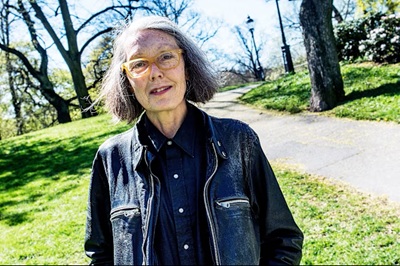
De Canadese dichteres, essayiste en vertaalster Anne Carson heeft de Nobelprijs voor Literatuur 2026 gewonnen. Anne Carson werd geboren op 21 juni 1950 in Toronto. Zie ook alle tags voor Anne Carson op dit blog.
Tango XXV. Sad Severe Tango Dance of Love and Death Dance of Night and Men Dance of the Dark Kitchen of the Poverty of Desire
Shall we sharpen our eyes and circle closer to the beauty of the husband—
carefully, for he was on fire.
Under him the floor was on fire,
the world was on fire,
truth was on fire.
Around him green fire blew straight off every tree.
He was almost never sad, a god led him on.
Nor did he doubt his fate which looked as Napoleon used to say like this:
I write myself between worlds.
What he wrote depended on who he was with.
Once he met Ray
he began to write paintings.
In Ray’s room they worked side by side, the husband talked.
Ray liked learning about places in the world,
for he had scarcely travelled and about books,
for he did not read.
What are the Alps like?
From the plane they look fragile like pieces of pottery. Thin silences float inbetween.
And up close.
Up close more like cheese. Parmesan.
Is it expensive.
Parmesan?
Italy.
Yes and no.
You stay with your Italian sweetie?
She got married.
To who.
Man named Ricky.
They happy?
She had to unlock him she said.
Meaning sex.
I guess.
You know what’s good for that is tango.
For unlocking?
Cures the digestion too.
How do you know these things.
Remember Flor?
No.
The one before Karl.
Karl?
Karl was the one before Danny.
Oh.
And Flor was a tangoist.
That seems a long time ago to me.
Poor pure Flor.
Seems so long ago.
Flor was defenseless.
Doesn’t that seem a long time ago to you Ray.
No not so long but you were married then it was all different.
It makes me tremble.
What.
To think back. I remember exactly how I thought life would be.
Everyone has dreams.
No not dreams it was a precise picture.
What went wrong.
Middlemen.
Sorry?
Take the divorce for example, not her idea to divorce me. Middlemen got to her.
She knew you were lying and sleeping around.
Ray please I never lied to her. When need arose I may have used words that lied.
Way too philosophical for me.
Philosophers say man forms himself in dialogue.
That I understand.
So did she.
Now there you’re wrong.
Why do you say so.
I saw her go down.
She was far stronger than me.
She went down.
Everything I did I did for her.
Why are you yelling.
I’m going to see her this weekend.
You’re insane.
I’ll write first.
She divorced you three years ago why not leave her alone.
I have faith.
In what.
In us.
There is no us.
Deep pure faith.
But why.
Ray you know I wish I lived in another century.
You used to say the body is the beginning of everything.
I don’t believe that anymore.
You still sleep around.
I do.
You make me sad.
The way people live here—
Yes.
Land of no miracles.
What do you hope for now.
To be reborn as a great warrior in the year 3001.
On a June evening.
What did you say.
It’s a line from a tango song.
On a June evening yes.
They went on working, he at his easel
and he on the floor by the lamp
while high black banks of twilight came and stood around them close
as sentries.
The husband was making a plan of the Battle of Epipolai
which he hoped to transfer to a wall of his house using acrylic paint
and small flags.
Why Epipolai? This bloody Athenian defeat
began with one surprise night move in 413 B.C.
Blurring a line between courage and folly
the Athenians attacked uphill in the dark
against fortified Syracusan positions.
Its originality at first
brought success to the plan,
then the Syracusans grasped it
and charged and disorder flowed everywhere.
Visibility was by moonlight,
they could see outlines but not who was who.
Hoplites got churning
in a space no bigger than a stairwell
for those Athenians who were already routed and descending the cliff
met others arriving fresh to the attack
and took them for enemies—moreover,
constantly shouting the password
they revealed it to the enemy and with this word
coming at them wrongly in the dark the Athenians panicked.
Friend fell upon friend.
It was like a beautiful boiling dance where your partner
turns
and stabs you to death,
cauldron of red Sicilian moon and white Greek lips.
He hums as he works.
Rectangles for the Syracusan outbuildings,
broken lines for the brave Athenian assault,
triangles for likely places of confrontation,
black dots of varying sizes for estimated casualties along the path of the rout.
In his mind
he is composing a letter
to explain to her (again)
about the fog of war and need for endurance and splendor
they will come to in the end.
We need a new password he whispers with a smile,
as he imagines himself arriving exhausted and hoarse,
dusty from the road, riding a tank one fine evening.
June evening.