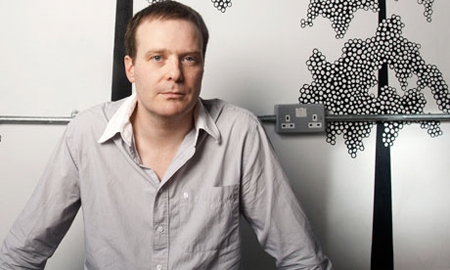
De Engelse schrijver en kunstenaar Tom McCarthy werd geboren op 22 mei 1969 in Londen. Zijn vader, Sir Callum McCarthy, werkte in de financiële sector. Hij was ambtenaar, eerst bij het Ministerie van Handel en Industrie, en vervolgens (in zijn laatste decennium) als financieel toezichthouder. Tom McCarthy groeide op in Greenwich en volgde onderwijs aan Dulwich College van 1978 tot 1986 en later aan New College, Oxford, waar hij Engelse literatuur studeerde. Hij woonde in Praag, waar hij werkte als naaktmodel en in een Amerikaanse bar; in Berlijn, waar hij in een Ierse pub werkte; en in Amsterdam, waar hij in de vroege jaren 90 in een restaurantkeuken werkte en boeken recenseerde voor de lokale editie van Time Out magazine, voordat hij terugkeerde naar Londen. McCarthy’s tijd in Praag vormt de basis voor zijn roman Men in Space. McCarthy heeft ook gewerkt als scriptredacteur voor televisie en was mederedacteur van Mute magazine. Sinds 2022 bekleedde McCarthy de functie van Miller Scholar aan het Santa Fe Institute, samen met Ted Chiang en Andrea Wulf. Na de Brexit verkreeg hij de Zweedse nationaliteit. Zijn debuutroman, “Remainder”, werd gepubliceerd in 2005. McCarthy is tweemaal genomineerd voor de Man Booker Prize en ontving in 2013 de eerste Windham-Campbell Literature Prize van Yale University. Hij won in 2008 een Believer Book Award voor “Remainder”. Hij schreef ook een kritische studie over Kuifje, getiteld “Tintin and the Secret of Literature”, en publiceerde in 2017 een essaybundel, “Typewriters, Bombs, and Jellyfish”. Zijn roman, “The Making of Incarnation”, werd gepubliceerd in 2021. In 2025 verscheen “The Threshold and the Ledger”.
Uit: Remainder
“About the accident itself I can say very little. Almost nothing. It involved something falling from the sky. Technology. Parts, bits. That’s it, really: all I can divulge. Not much, I know.
It’s not that I’m being shy. It’s just that—well, for one, I don’t even remember the event. It’s a blank: a white slate, a black hole. I have vague images, half-impressions: of being, or having been—or, more precisely, being about to be—hit; blue light; railings; lights of other colours; being held above some kind of tray or bed. But who’s to say that these are genuine memories? Who’s to say my traumatized mind didn’t just make them up, or pull them out from somewhere else, some other slot, and stick them there to plug the gap—the crater—that the accident had blown? Minds are versatile and wily things. Real chancers.
And then there’s the Requirement. The Clause. The terms of the Settlement drawn up between my lawyer and the parties, institutions, organizations—let’s call them the bodies—responsible for what happened to me prohibit me from discussing, in any public or recordable format (I know this bit by heart), the nature and/or details of the incident, on pain of forfeiting all financial reparations made to me, plus any surplus these might have accrued (a good word that, “accrued”) while in my custody—and forfeiting quite possibly, my lawyer told me in a solemn voice, a whole lot more besides. Closing the loop, so to speak.
The Settlement. That word: Settlement. Set-l-ment. As I lay abject, supine, tractioned and trussed up, all sorts of tubes and wires pumping one thing into my body and sucking another out, electronic metronomes and bellows making this speed up and that slow down, their beeping and rasping playing me, running through my useless flesh and organs like sea water through a sponge—during the months I spent in hospital, this word planted itself in me and grew. Settlement. It wormed its way into my coma: Greg must have talked about it to me when he came round to gawk at what the accident had left. As the no-space of complete oblivion stretched and contracted itself into gritty shapes and scenes in my unconscious head—sports stadiums mainly, running tracks and cricket pitches—over which a commentator’s voice was playing, inviting me to commentate along with him, the word entered the commentary: we’d discuss the Settlement, though neither of us knew what it entailed.“