Into the streets May First! Into the roaring Square! Shake the midtown towers! Shatter the downtown air! Come with a storm of banners, Come with an earthquake tread, Bells, hurl out of your belfries, Red flag, leap out your red! Out of the shops and factories, Up with the sickle and hammer, Comrades, these are our tools, A song and a banner! Roll song, from the sea of our hearts, Banner, leap and be free; Song and banner together, Down with the bourgeoisie! Sweep the big city, march forward, The day is a barricade; We hurl the bright bomb of the sun, The moon like a hand grenade. Pour forth like a second flood! Thunder the alps of the air! Subways are roaring our millions – Comrades, into the square!
Alfred Hayes (18 april 1911 – 14 augustus 1985) Brick Lane in Whitechapel, Londen, de geboorteplaats van Alfred Hayes
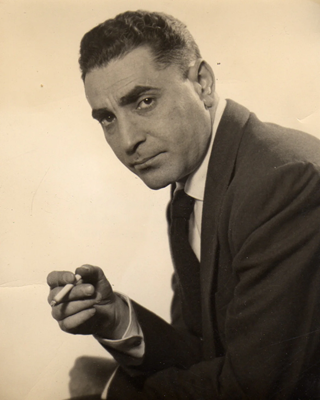
De Engelse dichter en schrijver Alfred Hayes werd geboren op 18 april 1911 in Londen. Hayes schreef scenario’s voor film en televisie, romans en poëzie. Hij woonde in Italië en de Verenigde Staten. Hij is vooral bekend om zijn gedicht “Joe Hill” (“Ik droomde dat ik Joe Hill vannacht zag…”), dat op muziek werd gezet door Earl Robinson. Hayes studeerde af aan het City College of New York (nu onderdeel van de City University of New York), werkte kort als journalist en begon zijn literaire carrière in de jaren 30. Tijdens de Tweede Wereldoorlog diende hij in Europa bij de Special Services van het Amerikaanse leger (de “Moral Division”). Daarna woonde hij in Rome en schreef scenario’s voor Italiaanse neorealistische films. Hij werd genomineerd voor een Academy Award als co-scenarist van Roberto Rossellini’s film Paisà (1946). Hij ontving nog een Oscarnominatie in 1951 voor Teresa. Hayes bewerkte zijn roman The Girl on the Via Flaminia ook tot een toneelstuk; het werd in 1953 verfilmd onder de titel Un acte d’amour (Een liefdesdaad). Hij was, zonder vermelding op de aftiteling, co-scenarist van Vittorio de Sica’s neorealistische film Bicycle Thieves (1948), waarvoor hij ook de Engelse ondertitels schreef. Zijn scenario’s in de VS omvatten The Lusty Men (1952, geregisseerd door Nicholas Ray) en de verfilming van de musical Lost in the Stars van Maxwell Anderson en Kurt Weill (1974). Hayes schreef ook televisiescripts voor de Amerikaanse series Alfred Hitchcock Presents, The Twilight Zone en Mannix. Tientallen jaren na Hayes’ dood in augustus 1985 kregen drie van zijn romans, “In Love” (1953), “My Face for the World to See” (1958) en “The End of Me” (1968), nieuwe edities onder de Classics-uitgave van The New York Review of Books. “In Love” en “My Face for the World to See” werden opnieuw uitgebracht in juli 2013 en “The End of Me” in juni 2020.
LIGHT AND LOVE
Front not the sun; or dazzled by his whiteness Earth’s face will seem expressionless and dim, Features confused and beauty drowned in brightness; But turn from him, And thou wilt find familiar scenes and homely Transfigured with a tender atmosphere; Scan not the source of all that makes earth comely; Enough that light is here.
Question not love; or pondering love’s essence The wonder of his glory will confound Those fair effects that issue from his presence; But look around, And thou wilt find the narrowest prospect spacious, And dark perplexities serenely clear; Scan not the source of all that makes life gracious; Enough that love is here.
THE CHAPEL
To the chapel, these weeping women, this sad Sunday come I To see his last; where boxed in, all quilted down, Plugged and powdered, here he is. Sorry for Sol, are you? Well, he’s dead, he’s quit of it, He’s had his; You’re the horse now, life on you, Your mouth cut by the bridle and bit of it. I’m here, dry eyed; here’s his shrunken mother, his best girl, His too-old younger brother; Flowers from the flower givers, speeches from the speech makers, Who make a moral, a sermon out of it, And I to make a verse. Of this poor eaten up, and chewed flesh, what’s there to say? I feel on my head the dub that clubbed him; I feel His diseases up in me; I grimace on his deathbed; what dizzied him makes me reel; I drown in his sea. O we are all in his wagon dull-riding to the graveyard, We’re all in his hearse, Leaving what he left: item, one starved mother; item, one best girl; Item, this poor verse.